

For decades, millions of Americans lived under a largely invisible financial punishment system that operated quietly beneath everyday life.
A missed traffic payment could spiral into suspended licenses. Court fees could grow into unpayable debt. Public defender costs could follow low-income families for years. Administrative surcharges, probation fees, collection penalties, reinstatement costs, and compounding municipal fines transformed ordinary financial hardship into long-term legal entanglement.
For many families, the punishment was not incarceration itself.
It was debt.
Debt that restricted mobility. Debt that blocked employment. Debt that damaged credit. Debt that trapped people inside cycles of poverty long after their original interaction with the justice system had ended.
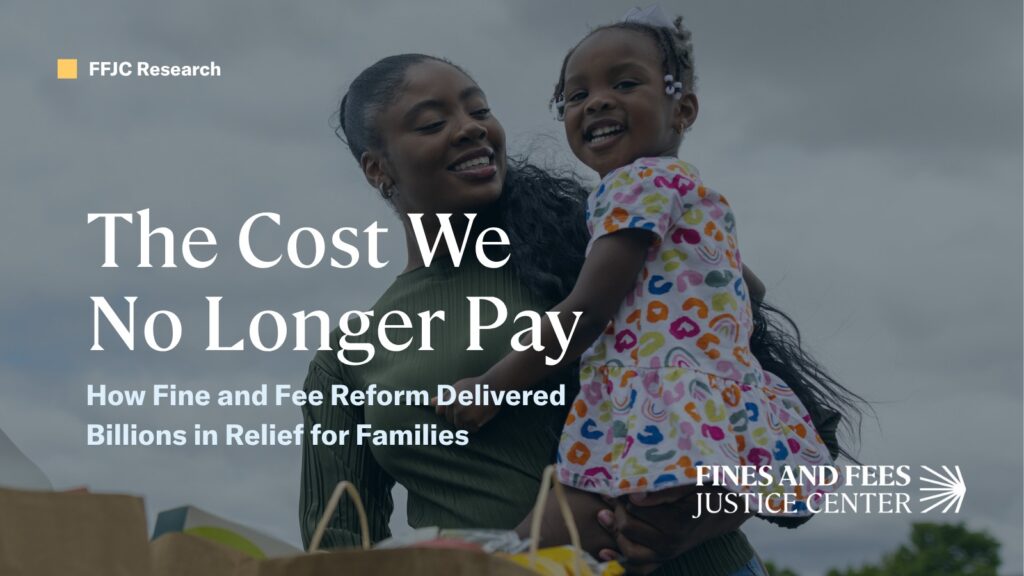
Now, according to a major new national report released by the Fines and Fees Justice Center titled The Cost We No Longer Pay, one of the most significant but underreported justice reform movements in America is beginning to reshape that reality.
The report calculates that bipartisan legislative reforms passed across the United States since 2018 have generated at least $37.5 billion in financial relief for American families. That number includes approximately $15.1 billion in regained earnings, $2.6 billion in discharged debt, and hundreds of millions more in waived, reduced, or prevented government-imposed fees tied to the legal system.
At Sustainable Action Now, conversations surrounding private prisons, criminal justice reform, municipal finance, and economic inequality increasingly intersect because modern punishment systems often extend far beyond incarceration itself. The fines-and-fees system has long functioned as a parallel financial punishment structure — one capable of trapping low-income individuals inside ongoing instability even when no ongoing public safety threat exists.
What makes the findings in The Cost We No Longer Pay especially important is that they reveal something many advocates, researchers, and impacted families have argued for years: the modern fines-and-fees structure frequently punished poverty more aggressively than misconduct itself.
And increasingly, lawmakers from both political parties appear willing to acknowledge that reality.
The report highlights 73 bipartisan legislative victories nationwide aimed at reducing or eliminating legal financial burdens imposed through courts, motor vehicle agencies, probation systems, public defender billing structures, and related government enforcement mechanisms.
New Jersey emerges as one of the most significant states within that reform movement.
The state has passed multiple high-profile reforms in recent years, including eliminating public defender fees, ending certain DMV-related surcharges, and stopping driver’s license suspensions tied to non-driving court debt. These changes may appear administrative on the surface, but their real-world impact on working families can be enormous.
At Sustainable Action Now, one of the most important aspects of this story is understanding how deeply embedded financial punishment systems became inside the American legal landscape over multiple decades.
Many municipal and state governments increasingly relied on fines, court fees, and administrative penalties as revenue-generation mechanisms, particularly during periods of budget strain. Over time, this created systems where low-income individuals often faced escalating financial consequences disconnected from actual public safety concerns.
A person unable to pay a traffic-related fine could lose driving privileges. Losing driving privileges could threaten employment. Employment instability could increase missed payments. Additional penalties would accumulate. Collection fees would expand. Warrants could eventually emerge over administrative noncompliance rather than dangerous conduct itself.
The cycle frequently became self-reinforcing.
This dynamic was especially severe in regions lacking robust public transportation infrastructure, where suspended licenses effectively eliminated reliable access to work, school, childcare, medical appointments, or basic economic participation.
The New Jersey reforms highlighted in the report directly targeted some of those structural problems.
Ending license suspensions for non-driving-related court debt reflects an important philosophical shift: recognizing that restricting mobility often worsens economic instability instead of improving accountability or compliance. If individuals cannot reach work consistently, their ability to resolve outstanding obligations only deteriorates further.
Similarly, eliminating public defender fees addresses another long-running criticism within criminal justice reform conversations.
Public defenders exist because constitutional protections guarantee legal representation regardless of income. Yet in many jurisdictions, low-income defendants were still billed afterward for the cost of that representation, effectively creating financial punishment for exercising basic constitutional rights.
Critics argued for years that such practices undermined the very principle of equal justice.
At Sustainable Action Now, another especially significant aspect of the report is the scale of regained earnings estimated nationally: $15.1 billion.
That figure reframes the conversation entirely.
This is not simply about debt cancellation or administrative relief. It is about economic participation. Families retaining earnings rather than losing wages through suspended licenses, court-related employment disruption, collection enforcement, escalating penalties, or repeated interactions with punitive administrative systems.
In other words, reforming fines and fees may function not only as justice reform, but as economic recovery policy.
That connection is increasingly important.
Low-income households already facing housing instability, rising healthcare costs, inflation pressures, wage stagnation, transportation expenses, and childcare burdens are often disproportionately harmed by compounding legal financial obligations. Even relatively small fines can become destabilizing when layered on top of existing economic precarity.
Once late penalties, surcharges, collections, and administrative enforcement mechanisms accumulate, financial recovery becomes extraordinarily difficult.
The report’s title — The Cost We No Longer Pay — captures this broader societal argument powerfully.
The “cost” refers not only to dollars extracted from individuals, but to broader systemic damage inflicted through policies that effectively criminalized poverty itself. Lost productivity, reduced workforce participation, housing instability, family stress, court congestion, administrative enforcement expenses, and long-term economic exclusion all carried societal costs extending far beyond individual debt balances.
At Sustainable Action Now, one of the most revealing aspects of this reform movement is its bipartisan nature.
In an era of extreme political polarization, fines-and-fees reform has increasingly drawn support across ideological lines for different reasons.
Progressive advocates often frame the issue through economic justice, racial inequity, and anti-poverty lenses.
Conservative reformers frequently emphasize government overreach, bureaucratic inefficiency, workforce participation, fiscal practicality, and reducing cycles of dependency or unnecessary legal entanglement.
This unusual coalition has helped accelerate reforms in states that otherwise disagree sharply on broader criminal justice issues.
The inclusion of New Jersey prominently within the report also reflects how state-level reforms increasingly shape national conversations surrounding justice modernization. New Jersey has become a particularly active laboratory for reforms involving bail systems, sentencing policy, marijuana legalization, driver’s license restoration, reentry access, and financial penalty restructuring over recent years.
These changes remain controversial in some political circles, particularly among critics who argue reduced enforcement may weaken accountability or municipal revenue stability. Yet reform advocates counter that accountability systems should not depend primarily on a person’s ability to pay.
That distinction sits at the center of the debate.
At Sustainable Action Now, another critical reality emerging from this report is that fines and fees often disproportionately impacted communities already facing broader structural inequities. Low-income residents, communities of color, immigrants, and economically marginalized populations frequently encountered higher exposure to enforcement systems while possessing fewer resources to resolve financial penalties quickly.
This compounded existing inequality dramatically.
A wealthy individual could often absorb a fine as inconvenience.
For struggling households, the same financial penalty could trigger cascading instability lasting years.
That disparity helped fuel growing criticism that the system effectively created two entirely different justice experiences based largely on income.
The broader implications of these reforms may become even more significant moving forward.
As states continue reevaluating how they fund courts, municipal systems, and administrative operations, pressure will likely grow to reduce dependency on punitive fee structures altogether. Simultaneously, growing attention toward reentry, workforce participation, homelessness prevention, and economic mobility is forcing policymakers to examine how legal debt contributes to long-term instability.
The Prison Policy Initiative’s inclusion of the report within its research library underscores how closely these issues connect to broader incarceration debates. Financial punishment systems frequently function as extensions of carceral control even outside prison walls themselves.
Court debt can prolong supervision. Administrative noncompliance can trigger warrants. License suspensions can increase police interactions. Economic instability can intensify legal vulnerability.
In this sense, fines-and-fees reform represents more than financial relief.
It represents partial dismantling of systems that often expanded punishment indefinitely through economic pressure rather than direct incarceration.
At Sustainable Action Now, perhaps the most important takeaway from The Cost We No Longer Pay is that many of these burdens were not inevitable. They were policy choices.
And because they were policy choices, they can be changed.
The reported $37.5 billion in relief therefore represents more than accounting data. It represents millions of moments where families kept income they otherwise would have lost, maintained driving privileges necessary for employment, escaped spiraling court debt, or regained stability after years trapped inside systems that frequently punished financial hardship more aggressively than actual danger.
That shift may ultimately become one of the most consequential — and least publicly understood — justice reform movements unfolding in America today.
Because for millions of people, freedom is not measured only by whether someone is behind bars.
Sometimes it is measured by whether a person can finally stop drowning in debt created by the system itself.