
Across the world, public attitudes toward captive wildlife are undergoing a profound transformation. Images and videos that once may have been dismissed as unfortunate but acceptable are now triggering international outrage, ethical scrutiny, and deeper conversations about the emotional and psychological realities of animals living in confinement. Few recent cases illustrate that shift more powerfully than the story of Tim, a brown bear living inside a severely restricted enclosure at Zoo Park Rožman in Slovenia.
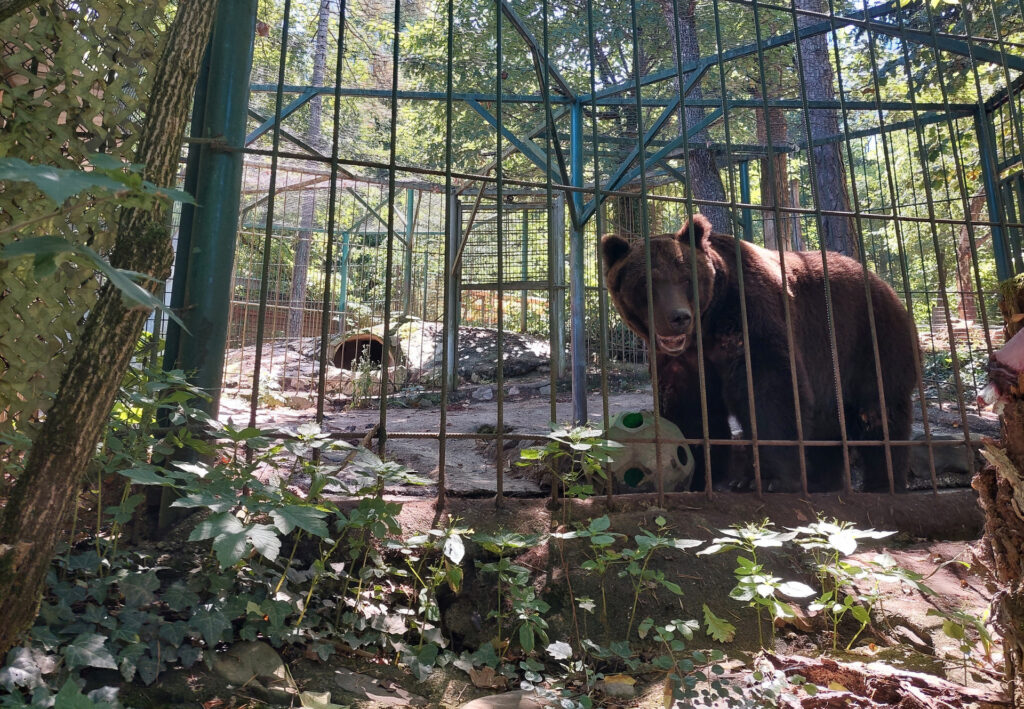
The footage recorded throughout March and April of 2026 does not simply show a captive bear. It shows the visible consequences of prolonged deprivation. It reveals an animal trapped inside an environment so limited, unstimulating, and psychologically restrictive that his body itself has become part of the prison. Tim paces repeatedly along the bars of his cage. He presses himself against the enclosure over and over again in compulsive cycles of movement. The patterns are relentless, repetitive, and deeply disturbing to watch because they reveal something modern animal welfare science has spent decades trying to explain: captivity can damage the mind as profoundly as it damages the body.
At Sustainable Action Now, discussions surrounding wildlife abuse and captivity are not driven by emotional reaction alone. They are rooted in a growing body of scientific understanding concerning animal cognition, trauma, environmental deprivation, and the ethical responsibilities humans carry when controlling the lives of intelligent sentient creatures. Tim’s story has become globally significant precisely because it forces a direct confrontation with a difficult truth many institutions still resist acknowledging — survival is not the same thing as wellbeing.
Legally, Tim’s conditions may reportedly remain compliant under current Slovenian regulations. Ethically, however, the footage has reignited urgent debate over how outdated wildlife laws continue failing animals whose psychological and behavioral needs are far more sophisticated than older captivity models ever accounted for.
This widening gap between legal acceptability and ethical adequacy is rapidly becoming one of the defining animal welfare issues of the modern era.
Brown bears are not passive display animals. They are highly intelligent omnivores capable of complex behaviors, environmental problem-solving, seasonal adaptation, spatial memory, exploration, and emotional responsiveness. In natural habitats, they roam enormous territories that may span miles upon miles of forests, rivers, mountains, and valleys. They dig, forage, swim, climb, investigate scents, manipulate objects, establish feeding routines, and interact dynamically with constantly changing surroundings.
Inside Tim’s enclosure, virtually all of those natural behaviors are functionally impossible.
This is one of the central tragedies of prolonged wildlife confinement. Captivity often strips animals not only of freedom but of behavioral purpose itself. A wild animal evolved for exploration becomes trapped in monotony. Instinctive behaviors lose outlets. Environmental stimulation disappears. Over time, the resulting psychological frustration frequently manifests as stereotypic behavior — repetitive actions with no apparent function other than coping with chronic stress, boredom, and deprivation.
Tim’s pacing is not entertainment. It is not habit. It is not random movement. It is a documented indicator of severe welfare compromise that animal behavior experts have observed across countless captive wildlife cases involving inadequate environments. These repetitive motions are frequently associated with anxiety, chronic stress, learned helplessness, neurological deterioration, and psychological distress resulting from confinement conditions that fail to meet species-specific needs.
What makes Tim’s case especially heartbreaking is the reported reality that this cage is all he has ever known. Since infancy, his life has existed within the limitations of confinement. There are no memories of forests. No experience roaming freely through natural terrain. No understanding of the world beyond bars, concrete, restricted pacing paths, and minimal enrichment objects. The entire scope of his existence has been defined by human-controlled restriction.
For many advocates, that reality transforms Tim from merely a captive animal into a symbol of a much larger systemic problem involving how societies continue rationalizing wildlife confinement despite increasingly overwhelming scientific evidence regarding animal cognition and emotional complexity.
The debate surrounding captive wildlife has evolved dramatically in recent decades because public understanding of animal intelligence has changed. Historically, many zoo and roadside exhibition models were built around visibility and display rather than psychological welfare. Animals were often evaluated primarily according to physical health metrics such as feeding, breeding, and disease prevention. If an animal survived and reproduced, conditions were frequently deemed acceptable.
Modern animal welfare science fundamentally challenges that framework.
Today, researchers increasingly recognize that psychological wellbeing, environmental complexity, autonomy, enrichment, behavioral diversity, and species-specific stimulation are essential components of humane care. An animal may appear physically intact while suffering profound psychological deterioration caused by chronic environmental inadequacy. Tim’s repetitive pacing patterns have become so emotionally impactful because viewers instinctively recognize signs of distress even without formal scientific training. The behavior communicates suffering visually and immediately.
This growing public awareness is reshaping the entire conversation around captivity. Increasingly, audiences no longer accept barren cages and repetitive animal behaviors as unfortunate but normal aspects of wildlife display. They understand that these behaviors often represent evidence of systemic welfare failure.
Tim’s situation has become especially significant because a viable alternative reportedly already exists. BEAR SANCTUARY Arbesbach has publicly stated that a large natural enclosure remains available and ready for his transfer. According to advocates, this sanctuary environment would provide thousands of square meters of natural terrain designed specifically to support species-appropriate behavior and rehabilitation opportunities.
That contrast between current confinement and potential sanctuary relocation is impossible to ignore.
In sanctuary settings, rescued bears often experience transformative behavioral changes after years of captivity. Bears previously confined to concrete enclosures may begin digging into soil for the first time. Others learn to forage naturally, swim, climb, rest in vegetation, or explore complex environments after decades without meaningful stimulation. Some rescued bears remain psychologically scarred permanently, but many still show dramatic improvements in stress reduction, behavioral diversity, and overall welfare when transferred into more natural habitats.
The sanctuary model itself represents a fundamentally different philosophy from traditional captive exhibition systems. Ethical sanctuaries are not built around spectacle, performance, or commercial entertainment. Their focus centers on rehabilitation, long-term care, trauma reduction, and maximizing quality of life for animals who cannot safely return to the wild. Environmental enrichment becomes a constant process rather than a minimal requirement. Space matters. Terrain matters. Privacy matters. Behavioral opportunity matters.
Tim’s continued confinement despite the existence of a sanctuary alternative raises difficult questions extending far beyond one facility in Slovenia. It forces broader examination of why outdated captivity systems continue persisting globally even as public ethics evolve. Why do some institutions resist transferring animals into more appropriate environments? Why do legal standards remain inconsistent internationally? Why are minimum welfare standards often treated as sufficient despite clear behavioral evidence suggesting otherwise?
These questions matter because Tim’s story is not isolated. Around the world, countless large mammals continue living in enclosures many experts consider psychologically inadequate. Bears, big cats, elephants, primates, marine mammals, and other intelligent species frequently become focal points in debates surrounding captivity precisely because their cognitive complexity makes behavioral distress especially visible.
At Sustainable Action Now, stories like Tim’s also intersect with broader conversations about sustainability itself. True sustainability cannot focus exclusively on environmental preservation while ignoring the suffering of individual animals trapped inside exploitative systems. Ethical stewardship requires confronting how humans manage, display, commercialize, and control wildlife under human authority. Conservation, biodiversity protection, habitat preservation, and animal welfare are interconnected issues rather than isolated categories.
The emotional intensity surrounding Tim’s story also reflects something deeper happening culturally. People increasingly reject the normalization of suffering disguised as entertainment or legality. The digital age has made hidden conditions visible in ways never previously possible. Social media campaigns, rescue footage, advocacy videos, and investigative reporting now allow global audiences to witness captivity conditions directly rather than relying solely on institutional narratives.
That visibility changes everything.
Once people see repetitive pacing, self-directed behaviors, empty enclosures, and psychological deterioration firsthand, it becomes much harder to maintain emotional distance. Tim’s movements communicate distress more powerfully than statistics or policy papers ever could. They force viewers to confront the lived reality of captivity in real time.
The case also highlights the enormous importance of advocacy organizations willing to continue applying pressure long after public attention cycles move on. Rescue campaigns involving large carnivores require sustained resources, international cooperation, veterinary planning, transport logistics, legal negotiations, habitat preparation, and long-term financial commitment. Sanctuaries capable of caring for rescued bears operate with immense ongoing expenses and depend heavily on public support to continue functioning.
This is why awareness campaigns matter even when progress feels slow. Every public conversation surrounding cases like Tim’s contributes to a larger cultural shift that increasingly prioritizes welfare, rehabilitation, and ethical accountability over outdated captivity traditions.
There is also an uncomfortable but necessary philosophical dimension to Tim’s story. Humans often admire wild animals symbolically while simultaneously restricting them physically. Bears represent wilderness, strength, intelligence, resilience, and untamed nature within human imagination. Yet captivity systems frequently reduce those same animals into repetitive movement patterns inside small artificial spaces. The contradiction becomes difficult to justify once the psychological consequences become visible.
And that may ultimately be why Tim’s story resonates so deeply across international audiences. He has become more than one captive bear. He has become evidence of the widening disconnect between what modern science understands about animal consciousness and what many legal systems still permit.
Every day Tim remains confined inside that enclosure reinforces the urgency of the larger conversation his story represents. Because the issue is no longer whether animals like Tim survive in captivity. The issue is whether survival alone can still be considered morally acceptable when psychological suffering has become so impossible to deny.
Tim’s pacing is not simply movement. It is communication. It is the visible manifestation of an animal deprived of nearly every instinctive behavior nature intended him to have. It is the consequence of confinement measured not just in years, but in lost experiences, lost autonomy, and a life spent within boundaries no wild brown bear should ever have to endure.
And until meaningful action replaces passive observation, Tim’s cage will continue standing not merely as an enclosure, but as a symbol of how much work modern society still has left to do in redefining what humane treatment truly means.