

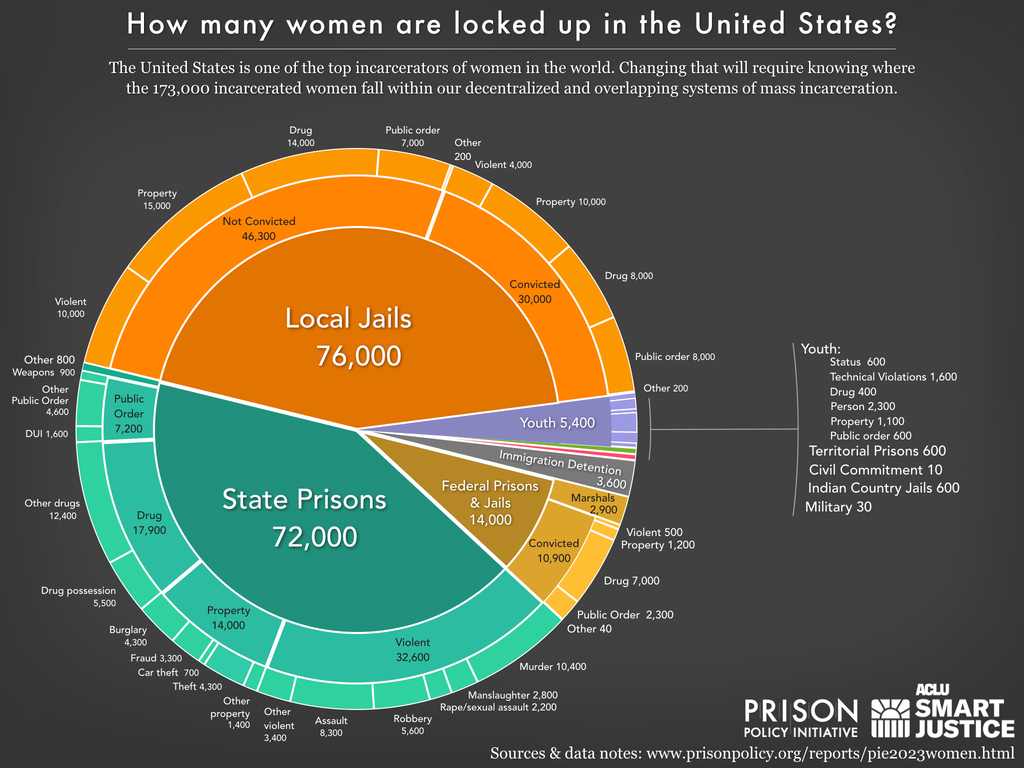
The conversation around incarceration in the United States is often framed in broad statistics, but the latest wave of updated data and visual analysis reveals something far more precise—and far more urgent. What emerges is not just a system under strain, but one defined by deep structural imbalances, accelerating disparities, and a growing disconnect between policy intent and human outcome. The newest insights now shaping the private prisons coverage at Sustainable Action Now bring renewed clarity to this reality, highlighting how incarceration continues to expand in ways that disproportionately impact women, intensify psychological harm, and reinforce systemic inequities that remain largely unresolved.
At the center of this updated analysis is a recalibration of how incarceration is measured and understood. National prison population counts, when viewed in isolation, can suggest stabilization or even modest decline in certain periods. But when examined more closely—across categories, demographics, and institutional layers—the data tells a different story. The total number of individuals held within the broader correctional system remains staggering, extending beyond prisons into jails, detention facilities, and other forms of custody that collectively define the true scale of incarceration in the United States.
One of the most significant shifts highlighted in the updated data is the continued rise in the incarceration of women. While men still represent the majority of the prison population, the rate at which women have been incarcerated over recent decades has outpaced that of men, signaling a distinct and accelerating trend. This is not a marginal issue—it reflects a systemic expansion of enforcement and sentencing practices that increasingly impact women, often in ways that intersect with broader social vulnerabilities such as economic instability, caregiving responsibilities, and exposure to prior trauma.
The implications extend far beyond individual cases. Women’s incarceration has a cascading effect on families and communities, particularly when primary caregivers are removed from households. The disruption of these family structures introduces long-term consequences that ripple outward, affecting children, economic stability, and community cohesion. These are not abstract outcomes—they are measurable, sustained impacts that compound over time, reinforcing cycles that the justice system is ostensibly designed to address.
Equally critical is the growing body of data focused on mental health within correctional environments. Updated metrics on psychological distress among incarcerated individuals reveal conditions that go beyond baseline stress or situational anxiety. The prevalence of serious psychological strain—often exacerbated by isolation, overcrowding, and limited access to adequate care—points to an environment that can intensify existing conditions while simultaneously creating new ones. This is particularly concerning given the already high rates of mental health challenges among incarcerated populations prior to entry into the system.
The data underscores a fundamental contradiction. Correctional facilities are increasingly functioning as de facto mental health institutions, yet they are structurally ill-equipped to provide the level of care required. The result is a system where individuals with significant mental health needs are placed in environments that may worsen their condition, creating a feedback loop that is both costly and ineffective. This dynamic raises critical questions about the role of incarceration as a response to social and health-related issues that might be more effectively addressed through alternative frameworks.
Disparities remain a defining feature across all categories of the updated data. Racial and socioeconomic inequities continue to shape who is incarcerated, how long they remain within the system, and the conditions they experience while there. These disparities are not incidental—they are embedded within the broader architecture of enforcement, sentencing, and resource allocation. The updated visualizations make these patterns unmistakably clear, offering a level of transparency that challenges simplified narratives about fairness and uniformity within the justice system.
The role of private prisons within this landscape adds another layer of complexity. As entities that operate within a profit-driven framework, private facilities introduce incentives that can conflict with broader goals of reducing incarceration rates and improving conditions. While they represent only a portion of the overall system, their presence raises critical questions about accountability, oversight, and the alignment of financial structures with public policy objectives. The updated data does not isolate these facilities from the broader system—it integrates them into a more comprehensive view that highlights how different components interact and influence outcomes.
What makes this latest release of data particularly significant is not just the information itself, but how it is presented. Updated charts and visualizations translate complex datasets into accessible formats, allowing patterns and disparities to be identified with greater clarity. This is more than a technical improvement—it is a strategic one. By making the data more understandable, it becomes more actionable, enabling a broader range of stakeholders to engage with the issues at a deeper level.
For Sustainable Action Now, this moment represents an opportunity to elevate the conversation. The goal is not simply to report on incarceration trends, but to contextualize them within a larger framework that considers sustainability in its fullest sense—social, economic, and human. A system that produces widespread psychological distress, disrupts communities, and perpetuates inequality cannot be considered sustainable, regardless of how it is managed or financed.
The path forward requires a reassessment of underlying assumptions. It requires questioning whether current approaches to incarceration are achieving their intended outcomes, and whether alternative models could produce better results with fewer negative consequences. It also requires a commitment to transparency, ensuring that data continues to be updated, refined, and made accessible so that policy decisions are informed by the most accurate and comprehensive information available.
There is no single metric that can capture the full scope of mass incarceration, just as there is no single solution that can address all of its complexities. But what the updated data makes clear is that the current trajectory demands attention. It demands a willingness to engage with uncomfortable realities and to consider changes that go beyond incremental adjustments.
This is not a static issue—it is an evolving one. As new data continues to emerge, it will further shape the understanding of how incarceration operates and who it affects. The responsibility now is to ensure that this understanding translates into meaningful action, guided by a commitment to equity, effectiveness, and long-term impact.
In the broader context of Sustainable Action Now, this is where the conversation becomes most critical. Sustainability is not limited to environmental considerations—it encompasses the systems that define how societies function and how individuals are treated within them. The updated data on incarceration is a clear reminder that these systems must be examined with the same level of rigor and accountability as any other domain.
What is now visible through these updated charts and metrics is not just a snapshot of the present, but a roadmap for what must be addressed moving forward. The scale is clear. The disparities are measurable. And the human cost is undeniable.