
There are few sights more powerful in animal rescue than watching a wild animal experience freedom for the first time.
Not freedom in the abstract sense. Not simply the absence of a cage. Real freedom. The freedom to climb, explore, forage, investigate new scents, dig through fresh soil, rest beneath trees, and make choices about how to spend the day. For animals born to roam forests, mountains, and wilderness landscapes, these seemingly simple opportunities represent something far greater than enrichment. They represent a return to life itself.
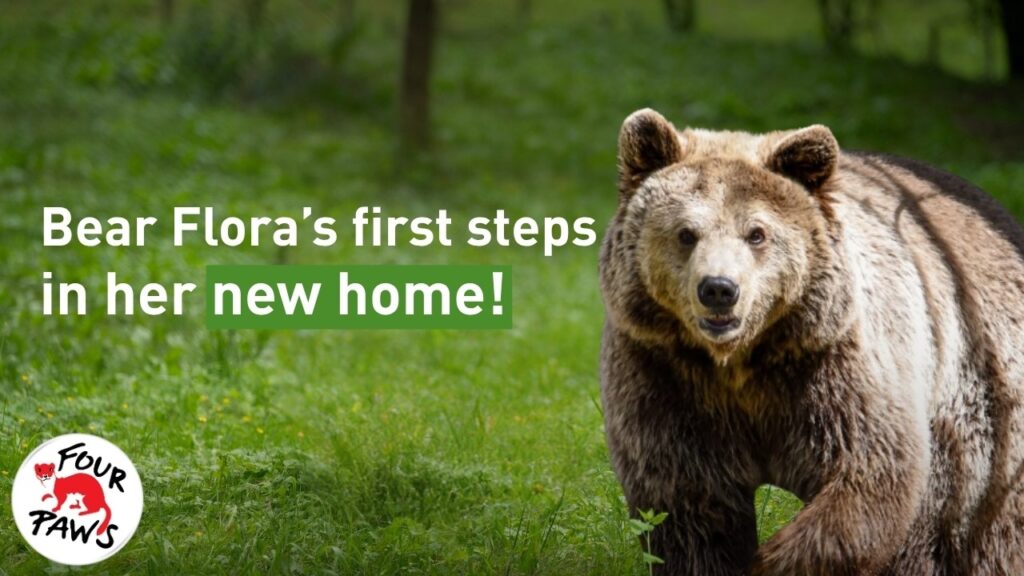
For Flora, a young brown bear rescued from illegal captivity in Albania, that transformation has been nothing short of extraordinary.
Today, Flora is thriving in her sanctuary home in Germany, where caretakers describe her as energetic, curious, intelligent, and constantly eager to explore every opportunity her new environment offers. Yet her current life stands in stark contrast to the conditions she endured during the first years of her existence.
Like countless wild animals caught in the illegal wildlife trade, Flora’s story began with deprivation.
Believed to have been taken from the wild as a cub, Flora spent her earliest years confined in a barren enclosure that offered none of the elements essential to a healthy bear’s physical and psychological development. There were no forests to explore, no natural terrain to investigate, no opportunities to forage, climb, dig, or hibernate. Instead, her world consisted largely of confinement, isolation, and a bed of rocks.
For an animal whose species evolved to travel extensive distances across diverse landscapes, the consequences of such deprivation can be profound.
Brown bears are among the most intelligent and adaptable mammals on Earth. In natural environments, they spend their lives navigating complex ecosystems, searching for food, responding to seasonal changes, exploring vast territories, and engaging in a wide range of behaviors that help maintain both physical and psychological health. Their lives are defined by movement, curiosity, and environmental interaction.
When those natural behaviors are stripped away through captivity, the impact extends far beyond physical confinement.
Wild animals require stimulation, challenge, and choice. Without those opportunities, stress, frustration, and behavioral abnormalities frequently emerge. This reality has become increasingly recognized by animal welfare experts around the world, who continue to push for stronger protections against private wildlife ownership and the exploitation of wild animals for entertainment purposes.
Flora’s rescue became possible through the efforts of animal welfare advocates determined to provide her with a future that reflected the needs of her species rather than the limitations imposed by captivity.
Transporting a large carnivore across international borders is a complex undertaking requiring extensive planning, veterinary oversight, specialized equipment, and extraordinary coordination. Yet for organizations committed to wildlife rescue, these efforts represent more than logistics. They represent a chance to fundamentally change the trajectory of an animal’s life.
When Flora finally arrived at her new sanctuary home in Germany, caretakers prepared for what is often a lengthy adjustment process.
Every rescued bear responds differently when introduced to a vastly improved environment. Some animals remain cautious for weeks or months, slowly venturing into outdoor spaces after years of confinement. Others require extended periods to build confidence and trust. The psychological effects of captivity do not simply disappear overnight.
Flora, however, had other plans.
Almost immediately, she began embracing every opportunity available to her.
The sanctuary’s enrichment features quickly became objects of fascination. A swing constructed from repurposed fire hoses became an instant favorite. Elevated platforms designed for climbing, resting, and observation were enthusiastically explored. New scents, textures, foods, and environmental features were investigated with the kind of curiosity that demonstrates just how eager she was to engage with the world around her.
For her caretakers, Flora’s rapid adaptation became a reminder of something both inspiring and heartbreaking.
The inspiring part is obvious. Despite years of deprivation, her natural instincts remained intact. Her curiosity survived. Her intelligence survived. Her desire to learn and explore survived.
The heartbreaking reality is that she should never have needed rescuing in the first place.
Flora’s story is not unique.
Across parts of Europe and around the world, wild animals continue to be illegally captured, privately owned, bred for entertainment, or confined in inadequate conditions that fail to meet even their most basic behavioral needs. Bears, big cats, primates, and countless other species remain trapped in circumstances that deny them the ability to express natural behaviors or experience anything resembling a species-appropriate life.
Many of these animals will never receive the opportunity Flora was given.
That reality underscores why individual rescue stories matter so deeply.
While every successful rescue deserves celebration, each case also serves as a reminder of the broader systems that continue allowing wildlife exploitation to persist. Illegal ownership, weak enforcement mechanisms, insufficient penalties, public demand for exotic animals, and gaps in animal welfare protections all contribute to an environment where suffering can continue largely unseen.
The challenge extends beyond individual animals.
It is ultimately about changing attitudes toward wildlife itself.
For decades, many societies tolerated the idea that wild animals could be owned, displayed, confined, or used for entertainment with relatively little consideration for their long-term welfare. Increasingly, however, scientific understanding and public awareness are reshaping those assumptions.
Modern animal welfare science continues revealing what many advocates have argued for years: wild animals possess complex cognitive abilities, emotional capacities, and behavioral needs that cannot be adequately met in most captive environments. The more society learns about these animals, the harder it becomes to justify systems that prioritize human amusement over animal wellbeing.
Sanctuaries provide a powerful alternative.
Unlike facilities focused on exhibition, ethical sanctuaries prioritize rehabilitation, recovery, and quality of life. Their purpose is not to display animals but to provide the best possible environment for individuals who can never safely return to the wild.
For bears like Flora, that means access to natural terrain, enrichment activities, diverse diets, opportunities for exploration, and the freedom to make choices throughout the day.
Those choices matter.
A bear deciding whether to climb a platform, investigate a scent trail, dig in fresh soil, or rest beneath a tree may seem ordinary to human observers. Yet for an animal that spent years deprived of such opportunities, each decision represents a restoration of autonomy that captivity once denied.
Watching Flora embrace those opportunities is more than a heartwarming rescue story. It is evidence of resilience.
It demonstrates the remarkable capacity of animals to recover when provided with proper care and appropriate environments. It shows how quickly natural behaviors can emerge when barriers are removed. Most importantly, it reveals what becomes possible when compassion is matched with action.
At Sustainable Action Now, stories like Flora’s serve as powerful reminders that animal welfare is not simply about preventing cruelty. It is about creating conditions where animals can truly thrive.
The success of one rescued bear does not erase the suffering of countless others still trapped in inadequate conditions. But it does offer something equally important: proof that change is possible.
Every sanctuary built, every rescue completed, every law strengthened, and every act of advocacy brings society one step closer to a future where wild animals are no longer treated as property, attractions, or commodities.
For Flora, that future has already begun.
The young bear who once knew only confinement now spends her days climbing, exploring, playing, foraging, and discovering a world that had been denied to her for far too long.
Her story is ultimately one of transformation.
Not simply from captivity to sanctuary, but from survival to living.
And for a bear who spent her earliest years surrounded by little more than rocks and barriers, that transformation may be the most remarkable rescue of all.